
- Form
- Literary fiction
- Length
- About 60,000 words
- Structure
- Fifty-three chapters in five parts and an epilogue
- Status
- In final revision. Coming late 2026.
- Formats
- Paperback, hardcover, ebook and audio
Coming late 2026 · A novel
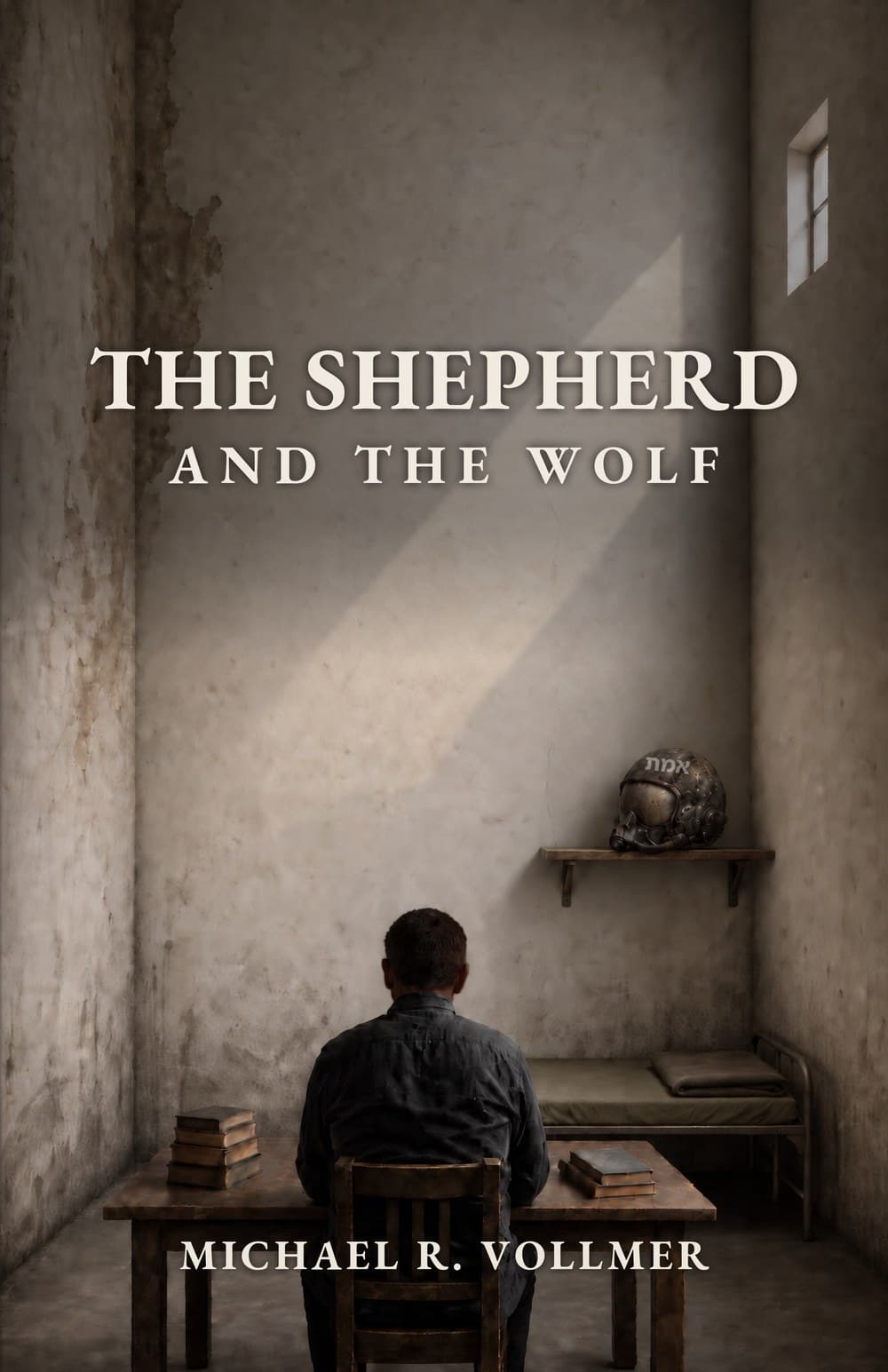
The Shepherd and the Wolf
by Michael R. Vollmer
Israel is gone. On the sixth day of a war, Joel looks down from his aircraft and his country is not there. Then he is hit, and comes down across the border.
He is thirty-eight. He sells and services commercial refrigeration and flies when the reserve calls him. He has not been inside a synagogue, except for two funerals and a wedding, in eleven years. His prayers are a card handed to him at his mother's grave, with what the words meant printed on the back.
In a tall white room, Christian clergy and Muslim scholars arrive with books, arguments, and offers. They are courteous. They are sincere. They want one sentence from him, naming which of them inherits the faith, the history, and the holy places of a people who can no longer be found. Nobody promises him his life for it, and nobody needs to explain what refusing it costs.
There is nobody left to ask. No rabbi, no mother, no government, no voice on the radio. Joel does not believe one man can sign a people away, and he is less sure the man should be him. He is not a believer, which turns out to be no help at all.
The flock has lost a sheep. Nobody is looking for the wolf. And the shepherds have come to ask the sheep whose fold it was.
First lines
A shepherd may be negligent tending his flock, allowing a wolf to eat one of the sheep. People will always kill the wolf, never blame the shepherd.
— Ronald C. Orovan
Part One · The Sky · 1 · Doves
There were four of them out on the apron, walking in the heat that came up off the concrete, stopping and starting the way doves do, attending to things that were not there.
Then the siren went, and they were gone — up and out over the eucalyptus at the edge of the field, all four in the same half second, as though the sound had lifted them rather than frightened them.
Joel watched them go. It was the fourth siren since morning and the second in an hour, and by now it meant nothing except that somebody at a console had done the correct thing.
How this book came to be
A note from the author, printed at the back of the book.
While clearing out an apartment I discovered an unpublished screenplay, written nearly forty years earlier — The Man Who Fell to Earth — along with notebooks, research materials, fragments of dialogue, theological questions, and pages of ideas surrounding the story.
They were Ronald C. Orovan's. He died on August 2, 2026.
He had kept everything. Boxes of paper going back to the 1980s. Forty years of road maps. Telephone directories nobody had opened. Moving boxes still taped shut, with his family's things in them, never unpacked.
What I found was not the novel you have just read. But within those pages was its foundation: a man facing an impossible choice, questions of faith and survival, and Ronald's persistent interest in what people and institutions are capable of doing when they believe the greater good is at stake.
The title of this book is his. It is a line from one of the notebooks, and it stands at the front.
I took Ronald's original concept and writings and began developing them into something larger. Characters were expanded and created, the world and circumstances were rebuilt, the story was restructured, and the underlying questions were developed into this novel.
I should say plainly how it was made, since this is a book about a statement put out in a man's name. The concept was Ronald's. The story is mine — what happens and in what order, what is invented and what is refused, where it ends. I drafted it with generative AI as a tool, working from my own outlines, and nothing stayed on the page that I had not read, argued with, and chosen to keep.
The Shepherd and the Wolf is my work, but it would not exist without Ronald's.
I am grateful that I had the opportunity to find what he left behind — and to carry his ideas somewhere he never had the chance to take them.
— Michael R. Vollmer